NESTML active dendrite tutorial
In this tutorial, we create a neuron model with a “nonlinear” or “active” dendritic compartment, that can, independently from the soma, generate a dendritic action potential. Instead of modeling the membrane potential of the dendritic compartment explicitly, the dendritic action potential (dAP) is modeled here as the injection of a rectangular (pulse shaped) dendritic current into the soma, parameterized by an amplitude and a duration. The rectangular shape can be interpreted as the approximation of an NMDA spike (Antic et al. 2010). A dendritic action potential is triggered when the total synaptic current exceeds a threshold.
The model is an adapted version of the neuron model introduced by Memmesheimer et al. (2012) and Jahnke et al. (2012), and has been used in (Bouhadjar et al., 2022).
Table of contents
[1]:
%matplotlib inline
import matplotlib as mpl
import matplotlib.pyplot as plt
import nest
import numpy as np
import os

from pynestml.codegeneration.nest_code_generator_utils import NESTCodeGeneratorUtils
              -- N E S T --
  Copyright (C) 2004 The NEST Initiative

 Version: 3.9.0-post0.dev0
 Built: Oct 10 2025 14:26:32

 This program is provided AS IS and comes with
 NO WARRANTY. See the file LICENSE for details.

 Problems or suggestions?
   Visit https://www.nest-simulator.org

 Type 'nest.help()' to find out more about NEST.
Adding dAP current to the model
We will use a standard, linear integrate-and-fire neuron with the governing equation:
\begin{align} \frac{dV_m}{dt} &= -\frac{1}{\tau_m} (V_m - E_L) + \frac{1}{C_m} (I_{syn} + I_{dAP}) \end{align}
Here, the term \(I_{syn}\) contains all the currents flowing into the soma due to synaptic input, and \(I_{dAP}\) contains the contribution of a dendritic action potential.
Implementing the pulse shape
The dAP current is modeled here as a rectangular (pulse) function, parameterized by an amplitude (current strength) and width (duration).
parameters:
    I_dAP_peak pA = 150 pA   # current clamp value for I_dAP during a dendritic action potential
    T_dAP ms = 10 ms         # time window over which the dendritic current clamp is active
    ...
We also define a synaptic current threshold that, when crossed, initiates the dendritic action potential:
parameters:
    I_th pA = 100 pA         # current threshold for a dendritic action potential
    ...
The current is switched on and off as follows. When a dendritic action potential is triggered, the magnitude of the I_dAP current is set to I_dAP_peak, and a timer variable t_dAP is set to the duration of the current pulse, T_dAP. At each future run of the NESTML update block, the timer is decremented until it reaches 0, at which point the dendritic action potential current I_dAP is set back to zero.
update:
    if t_dAP > 0 ms:
        # during a dendritic action potential pulse
        t_dAP -= resolution()
        if t_dAP <= 0 ms:
            # end of dendritic action potential
            I_dAP = 0 pA
            t_dAP = 0 ms

    if I_syn > I_th:
        # current-threshold, emit a dendritic action potential
        t_dAP = T_dAP
        I_dAP = I_dAP_peak
The complete neuron model is as follows:
[2]:
nestml_active_dend_model = """
model iaf_psc_exp_active_dendrite_neuron:
    state:
        V_m mV = 0 mV     # membrane potential
        t_dAP ms = 0 ms   # dendritic action potential timer
        I_dAP pA = 0 pA   # dendritic action potential current magnitude

    equations:
        # alpha shaped postsynaptic current kernel
        kernel syn_kernel = (e / tau_syn) * t * exp(-t / tau_syn)
        recordable inline I_syn pA = unit_psc * convolve(syn_kernel, spikes_in)
        V_m' = -(V_m - E_L) / tau_m + (I_syn + I_dAP + I_e) / C_m

    parameters:
        C_m pF = 250 pF          # capacity of the membrane
        tau_m ms = 20 ms         # membrane time constant
        tau_syn ms = 10 ms       # time constant of synaptic current
        V_th mV = 25 mV          # action potential threshold
        V_reset mV = 0 mV        # reset voltage
        I_e    pA = 0 pA         # external current
        E_L    mV = 0 mV         # resting potential

        # dendritic action potential
        I_th pA = 100 pA         # current threshold for a dendritic action potential
        I_dAP_peak pA = 150 pA   # current clamp value for I_dAP during a dendritic action potential
        T_dAP ms = 10 ms         # time window over which the dendritic current clamp is active

    internals:
        unit_psc pA = 1 pA

    input:
        spikes_in <- spike

    output:
        spike

    update:
        # solve ODEs
        integrate_odes()

        if t_dAP > 0 ms:
            t_dAP -= resolution()
            if t_dAP <= 0 ms:
                # end of dendritic action potential
                t_dAP = 0 ms
                I_dAP = 0 pA

    onCondition(I_syn > I_th):
        # current-threshold, emit a dendritic action potential
        t_dAP = T_dAP
        I_dAP = I_dAP_peak

    onCondition(V_m > V_th):
        # emit somatic action potential
        emit_spike()
        V_m = V_reset
"""
Save to a temporary file and make the model available to instantiate in NEST (see Running NESTML):
[3]:
module_name, neuron_name = NESTCodeGeneratorUtils.generate_code_for(nestml_active_dend_model,
                                                                    module_name="active_dend_module",
                                                                    logging_level="ERROR")  # try "INFO" or "DEBUG" for more debug information
              -- N E S T --
  Copyright (C) 2004 The NEST Initiative

 Version: 3.9.0-post0.dev0
 Built: Oct 10 2025 14:26:32

 This program is provided AS IS and comes with
 NO WARRANTY. See the file LICENSE for details.

 Problems or suggestions?
   Visit https://www.nest-simulator.org

 Type 'nest.help()' to find out more about NEST.
Running the simulation in NEST
Let’s define a function that will instantiate the active dendrite model, run a simulation, and plot and return the results.
[4]:
def evaluate_neuron(neuron_name, module_name, neuron_parms=None, t_sim=100., plot=True):
    """
    Run a simulation in NEST for the specified neuron. Inject a stepwise
    current and plot the membrane potential dynamics and action potentials generated.

    Returns the number of postsynaptic action potentials that occurred.
    """
    dt = .1   # [ms]

    nest.ResetKernel()
    try:
        nest.Install(module_name)
    except :
        pass
    neuron = nest.Create(neuron_name)
    if neuron_parms:
        for k, v in neuron_parms.items():
            nest.SetStatus(neuron, k, v)

    sg = nest.Create("spike_generator", params={"spike_times": [10., 20., 30., 40., 50.]})

    multimeter = nest.Create("multimeter")
    record_from_vars = ["V_m", "I_syn", "I_dAP"]
    if "enable_I_syn" in neuron.get().keys():
        record_from_vars += ["enable_I_syn"]
    multimeter.set({"record_from": record_from_vars,
                    "interval": dt})
    sr_pre = nest.Create("spike_recorder")
    sr = nest.Create("spike_recorder")

    nest.Connect(sg, neuron, syn_spec={"weight": 50., "delay": 1.})
    nest.Connect(multimeter, neuron)
    nest.Connect(sg, sr_pre)
    nest.Connect(neuron, sr)

    nest.Simulate(t_sim)

    mm = nest.GetStatus(multimeter)[0]
    timevec = mm.get("events")["times"]
    I_syn_ts = mm.get("events")["I_syn"]
    I_dAP_ts = mm.get("events")["I_dAP"]
    ts_somatic_curr = I_syn_ts + I_dAP_ts
    if "enable_I_syn" in mm.get("events").keys():
        enable_I_syn = mm.get("events")["enable_I_syn"]
        ts_somatic_curr = enable_I_syn * I_syn_ts + I_dAP_ts

    ts_pre_sp = nest.GetStatus(sr_pre, keys="events")[0]["times"]
    ts_sp = nest.GetStatus(sr, keys="events")[0]["times"]
    n_post_spikes = len(ts_sp)

    if plot:
        n_subplots = 3
        n_ticks = 4
        if "enable_I_syn" in mm.get("events").keys():
            n_subplots += 1
        fig, ax = plt.subplots(n_subplots, 1, dpi=100)
        ax[0].scatter(ts_pre_sp, np.zeros_like(ts_pre_sp), marker="d", c="orange", alpha=.8, zorder=99)
        ax[0].plot(timevec, I_syn_ts, label=r"I_syn")
        ax[0].set_ylabel("I_syn [pA]")
        ax[0].set_ylim(0, np.round(1.1*np.amax(I_syn_ts)/50)*50)
        ax[0].yaxis.set_major_locator(mpl.ticker.LinearLocator(n_ticks))
        twin_ax = ax[0].twinx()
        twin_ax.plot(timevec, I_dAP_ts, linestyle="--", label=r"I_dAP")
        twin_ax.set_ylabel("I_dAP [pA]")
        twin_ax.set_ylim(0, max(3, np.round(1.1*np.amax(I_dAP_ts)/50)*50))
        twin_ax.legend(loc="upper right")
        twin_ax.yaxis.set_major_locator(mpl.ticker.LinearLocator(n_ticks))
        ax[-2].plot(timevec, ts_somatic_curr, label="total somatic\ncurrent")
        ax[-2].set_ylabel("[pA]")
        if "enable_I_syn" in mm.get("events").keys():
            ax[1].plot(timevec, enable_I_syn, label="enable_I_syn")
            ax[1].set_ylim([-.05, 1.05])
            ax[1].set_yticks([0, 1])
        ax[-1].plot(timevec, mm.get("events")["V_m"], label="V_m")
        ax[-1].scatter(ts_sp, np.zeros_like(ts_sp), marker="d", c="olivedrab", alpha=.8, zorder=99)
        ax[-1].set_ylabel("V_m [mV]")
        ax[-1].set_xlabel("Time [ms]")
        for _ax in set(ax) | set([twin_ax]):
            _ax.grid()
            if not _ax == twin_ax: _ax.legend(loc="upper left")
            if not _ax == ax[-1]: _ax.set_xticklabels([])
            for _loc in ["top", "right", "bottom", "left"]:
                _ax.spines[_loc].set_visible(False) # hide axis outline
        for o in fig.findobj(): o.set_clip_on(False)  # disable clipping
        plt.show()
        plt.close(fig)

        return n_post_spikes
[5]:
n_post_sp = evaluate_neuron(neuron_name, module_name,
                            neuron_parms={"I_th": 100., "I_dAP_peak": 400.})
assert n_post_sp == 2   # check for correctness of the result
Jan 22 00:10:43 Install [Info]:
    loaded module active_dend_module

Jan 22 00:10:43 NodeManager::prepare_nodes [Info]:
    Preparing 5 nodes for simulation.

Jan 22 00:10:43 SimulationManager::start_updating_ [Info]:
    Number of local nodes: 5
    Simulation time (ms): 100
    Number of OpenMP threads: 1
    Not using MPI

Jan 22 00:10:43 SimulationManager::run [Info]:
    Simulation finished.
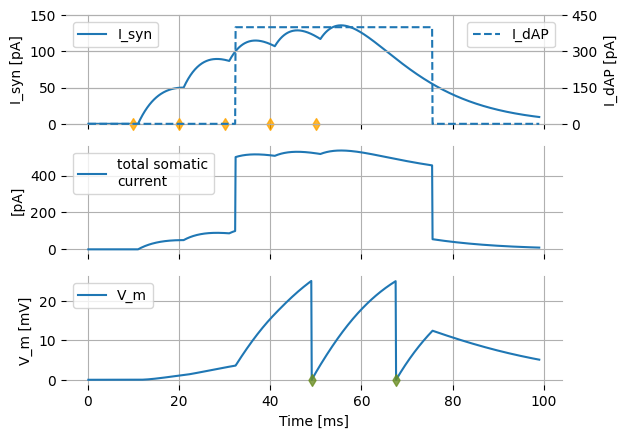
In the top panel, we can see the synaptic and dAP currents separately. Incoming action potentials from the presynaptic partner, triggering postsynaptic currents, are indicated by orange diamonds ♦. The middle panel shows the total synaptic current, which is equal to the sum of synaptic and dendritic action potential current. The bottom panel shows the resulting postsynaptic membrane potential, and postsynaptic (somatic) action potentials using green diamonds ♦.
The presynaptic action potentials by themselves are not sufficient by themselves to trigger a postsynaptic action potential, which can be seen by setting the dAP threshold to a very high value, preventing it from triggering. No postsynaptic spikes are observed.
[6]:
n_post_sp = evaluate_neuron(neuron_name, module_name,
                            neuron_parms={"I_th": 9999.})
assert n_post_sp == 0   # check for correctness of the result
Jan 22 00:10:43 Install [Info]:
    loaded module active_dend_module

Jan 22 00:10:43 NodeManager::prepare_nodes [Info]:
    Preparing 5 nodes for simulation.

Jan 22 00:10:43 SimulationManager::start_updating_ [Info]:
    Number of local nodes: 5
    Simulation time (ms): 100
    Number of OpenMP threads: 1
    Not using MPI

Jan 22 00:10:43 SimulationManager::run [Info]:
    Simulation finished.

Dynamically controlling synaptic integration
We now add the additional requirement for the dendritic action potential to disable synaptic integration. When a dendritic action potential happens, we want to ignore synaptic currents for the duration of the action potential, and to reset the synaptic currents such that any presynaptic activity before the dendritic action potential is ignored.
To do this, we add a state variable enable_I_syn, that will have the value 1 if synaptic current integration is enabled, and 0 in case it is disabled. This variables multiplies the I_syn term in the differential equation for \(V_m\). The new governing equation is then:
\begin{align} \frac{dV_m}{dt} &= -\frac{1}{\tau_m} (V_m - E_L) + \frac{1}{C_m} (\mathtt{enable\_I\_syn} \cdot I_{syn} + I_{dAP}) \end{align}
We can then temporarily disable the synaptic current from contributing to the update of V_m by setting enable_I_syn to zero, for instance:
update:
    if I_syn > I_th:
        # current-threshold, emit a dendritic action potential
        ...
        # temporarily pause synaptic integration
        enable_I_syn = 0.
        ...
In order to ignore presynaptic input that arrives during and before a dendritic action potential, we write the postsynaptic response as ODEs rather than using convolutions. Usually, synaptic integration is expressed as a convolution, for example:
equations:
    kernel syn_kernel = (e / tau_syn) * t * exp(-t / tau_syn)    # alpha kernel

    V_m' = -(V_m - E_L) / tau_m + convolve(syn_kernel, in_spikes) / C_m
    ...
Instead, we will write out the postsynaptic response explicitly as an ODE (or system of ODEs) so the variables can be assigned to. In the case of an alpha kernel, the equivalent system of ODEs is two-dimensional; we will use a notation with the $ symbol to denote the auxiliary variable.
state:
    I_syn pA = 0 pA
    I_syn$ pA/ms = 0 pA/ms

equations:
    # alpha shaped postsynaptic current kernel
    I_syn' = I_syn$ - I_syn / tau_syn
    I_syn$' = -I_syn$ / tau_syn

internals:
    unit_psr pA/ms = pA * exp(1) / tau_syn    # Unitary postsynaptic response amplitude

onReceive(spikes_in):
    I_syn$ += unit_psr * spikes_in * s
Now, we can not only use the variable I_syn and I_syn$ in expressions, but we can also assign to them. Thus, to reset the state of synaptic integration (thereby “forgetting” any past action potential events):
update:
    ...
    if t_dAP <= 0 ms:
        # end of dendritic action potential
        ...
        I_syn = 0 pA
        I_syn$ = 0 pA/ms
        ...
Putting it all together in a new model, we have:
[7]:
nestml_active_dend_reset_model = """
model iaf_psc_exp_active_dendrite_resetting_neuron:
    state:
        V_m mV = 0 mV     # membrane potential
        t_dAP ms = 0 ms   # dendritic action potential timer
        I_dAP pA = 0 pA   # dendritic action potential current magnitude
        I_syn pA = 0 pA   # postsynaptic current
        I_syn$ pA/ms = 0 pA/ms   # postsynaptic current rate of change
        enable_I_syn real = 1.   # set to 1 to allow synaptic currents to        # <----
                                 # contribute to V_m integration, 0 otherwise    # <----

    equations:
        # alpha shaped postsynaptic current kernel
        I_syn' = I_syn$ - I_syn / tau_syn
        I_syn$' = -I_syn$ / tau_syn

        V_m' = -(V_m - E_L) / tau_m + (enable_I_syn * I_syn + I_dAP + I_e) / C_m

    parameters:
        C_m pF = 250 pF          # capacity of the membrane
        tau_m ms = 20 ms         # membrane time constant
        tau_syn ms = 10 ms       # time constant of synaptic current
        V_th mV = 25 mV          # action potential threshold
        V_reset mV = 0 mV        # reset voltage
        I_e    pA = 0 pA         # external current
        E_L    mV = 0 mV         # resting potential

        # dendritic action potential
        I_th pA = 100 pA         # current-threshold for a dendritic action potential
        I_dAP_peak pA = 150 pA   # current clamp value for I_dAP during a dendritic action potential
        T_dAP ms = 10 ms         # time window over which the dendritic current clamp is active

    internals:
        unit_psr pA/ms = pA * exp(1) / tau_syn         # Unitary postsynaptic response amplitude

    input:
        spikes_in <- spike(weight pA)

    output:
        spike

    onReceive(spikes_in):
        I_syn$ += unit_psr * spikes_in * s

    update:
        # solve ODEs
        integrate_odes()

        if t_dAP > 0 ms:
            t_dAP -= resolution()
            if t_dAP <= 0 ms:
                # end of dendritic action potential
                t_dAP = 0 ms
                I_dAP = 0 pA
                # reset and re-enable synaptic integration
                I_syn = 0 pA                                 # <----
                I_syn$ = 0 pA/ms                             # <----
                enable_I_syn = 1.                            # <----

    onCondition(I_syn > I_th):
        # current-threshold, emit a dendritic action potential
        t_dAP = T_dAP
        I_dAP = I_dAP_peak
        # temporarily pause synaptic integration             # <----
        enable_I_syn = 0.                                    # <----

    onCondition(V_m > V_th):
        # emit somatic action potential
        emit_spike()
        V_m = V_reset
"""
Save to a temporary file and make the model available to instantiate in NEST (see Running NESTML):
[8]:
module_name, neuron_name = NESTCodeGeneratorUtils.generate_code_for(nestml_active_dend_reset_model,
                                                                    module_name="active_dend_reset_module",
                                                                    logging_level="ERROR")  # try "INFO" or "DEBUG" for more debug information
              -- N E S T --
  Copyright (C) 2004 The NEST Initiative

 Version: 3.9.0-post0.dev0
 Built: Oct 10 2025 14:26:32

 This program is provided AS IS and comes with
 NO WARRANTY. See the file LICENSE for details.

 Problems or suggestions?
   Visit https://www.nest-simulator.org

 Type 'nest.help()' to find out more about NEST.
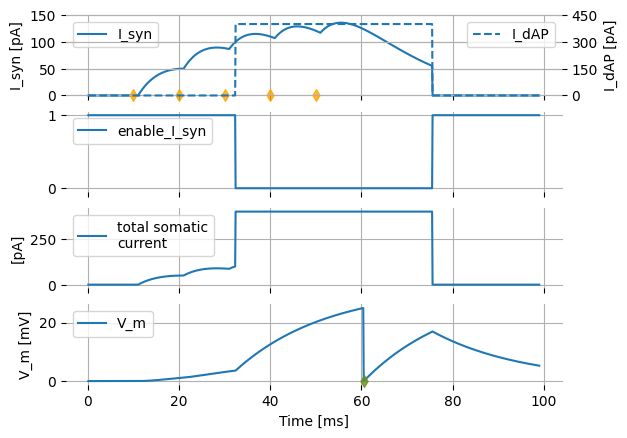
If we run the simulation with the same parameters as last time, we now observe only one instead of two action potentials, because the synaptic current (shown as I_syn in the top subplot below) does not contribute to V_m during the dendritic action potential interval.
[9]:
n_post_sp = evaluate_neuron(neuron_name, module_name,
                            neuron_parms={"I_th": 100., "I_dAP_peak": 400.})
assert n_post_sp == 1   # check for correctness of the result
Jan 22 00:10:49 Install [Info]:
    loaded module active_dend_reset_module

Jan 22 00:10:49 NodeManager::prepare_nodes [Info]:
    Preparing 5 nodes for simulation.

Jan 22 00:10:49 SimulationManager::start_updating_ [Info]:
    Number of local nodes: 5
    Simulation time (ms): 100
    Number of OpenMP threads: 1
    Not using MPI

Jan 22 00:10:49 SimulationManager::run [Info]:
    Simulation finished.
Acknowledgements
We extend our gratitude to Younes Bouhadjar and Tom Tetzlaff for their contributions.
This software was developed in part or in whole in the Human Brain Project, funded from the European Union’s Horizon 2020 Framework Programme for Research and Innovation under Specific Grant Agreements No. 720270 and No. 785907 (Human Brain Project SGA1 and SGA2).
References
Jahnke, S., Timme, M. & Memmesheimer, R. M. (2012). Guiding synchrony through random networks. Physical Review X, 2(4), 041016. https://doi.org/10.1103/PhysRevX.2.041016
Memmesheimer, R. M. & Timme, M. (2012). Non-additive coupling enables propagation of synchronous spiking activity in purely random networks. PLoS Comput Biol, 8(4), e1002384. https://doi.org/10.1371/journal.pcbi.1002384
Antic, S.D. Zhou, W.-L., Moore, A.R., Short, S.M., & Ikonomu, K.D. (2010). The Decade of the Dendritic NMDA Spike. J Neurosci Res. Nov 1, 88(14). https://doi.org/10.1002/jnr.22444
Bouhadjar, Y., Wouters, D. J., Diesmann, M., & Tetzlaff, T. (2022). Sequence learning, prediction, and replay in networks of spiking neurons. PLoS Computational Biology, 18(6), e1010233.
Copyright
This file is part of NEST.
Copyright (C) 2004 The NEST Initiative
NEST is free software: you can redistribute it and/or modify it under the terms of the GNU General Public License as published by the Free Software Foundation, either version 2 of the License, or (at your option) any later version.
NEST is distributed in the hope that it will be useful, but WITHOUT ANY WARRANTY; without even the implied warranty of MERCHANTABILITY or FITNESS FOR A PARTICULAR PURPOSE. See the GNU General Public License for more details.
You should have received a copy of the GNU General Public License along with NEST. If not, see http://www.gnu.org/licenses/.